
Three Lessons from Marriott – The World’s Largest Hotel Chain
Table of Contents
Introduction: From Root Beer Stand to Global Hospitality Leader
The Asset-Light Model: Why Marriott Owns Less Than 0.5% of Its Hotels
One Group, Many Brands: The Power of Strategic Segmentation
Loyalty as Revenue Infrastructure: Inside the Marriott Bonvoy Engine
Conclusion: Structure, Strategy, and Scalable Growth
Introduction: From Root Beer Stand to Global Hospitality Leader
Marriott International is undoubtedly a leader in the hospitality industry. With over 9,700 properties across 143 countries and territories, it boasts one of the most powerful hotel portfolios in the world.
But what many don’t know is that Marriott began nearly 100 years ago as a small A&W Root Beer stand in Washington, D.C., in 1927. From serving beer to becoming a global hotel powerhouse, its transformation is nothing short of remarkable.
So, how did Marriott grow from a single beverage stand into a hospitality giant in just a century? Let’s explore the strategies and innovations behind its success.
The Asset-Light Model: Why Marriott Owns Less Than 0.5% of Its Hotels
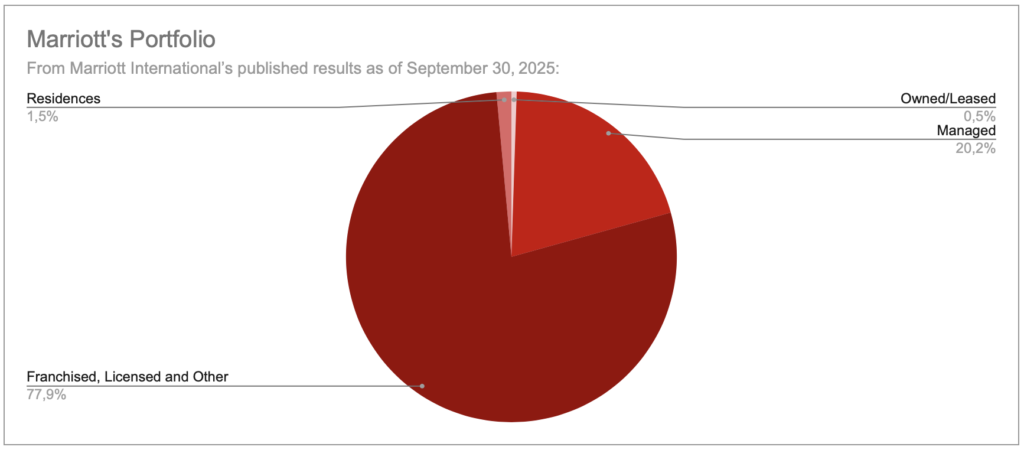
Out of more than 9,700 properties under the Marriott brand, the company owns only about 50, which is less than 0.5% of its portfolio. Around 20% of its hotels are managed directly by Marriott on behalf of owners, while the vast majority — nearly 78% — are franchised.
This franchise-focused, asset-light model is one of Marriott’s key success factors. By relying on franchising, Marriott can expand rapidly across the globe without heavy capital investment, maintain brand consistency, and focus on managing systems, data, and guest experience rather than managing real estate.
So what is the lesson here?
Expansion does not necessarily require heavy capital investment. Growth can be achieved through partnerships — provided that the system is strong enough to protect the brand.
Franchising does involve a trade-off: less direct operational control. However, this risk can be mitigated through:
- clearly defined brand standards
- rigorous onboarding processes
- structured performance monitoring
- regular audits and compliance checks
- centralized revenue and distribution oversight
When governance is strong, franchising becomes a growth accelerator rather than a dilution risk.
If there is ever doubt about the effectiveness of this model, Marriott’s scale and performance speak for themselves. The company proves that ownership is not the only — nor necessarily the best — path to global dominance.
One Group, Many Brands: The Power of Strategic Segmentation
When you hear “a Marriott hotel,” what comes to your mind? A luxury resort? A business hotel in the city center? A budget-friendly stay? The correct answer is — all of the above.
Marriott’s strength lies in the diversity of its portfolio. The group includes brands across every segment of hospitality, designed to serve different travel occasions and guest profiles. Whether it’s a business traveler on a short work trip, a family seeking a long-stay apartment, a high-end guest looking for a luxury escape, or a young traveler searching for an affordable stay — Marriott has a brand tailored to each of them.
What makes this strategy powerful is precise guest segmentation. Each brand is intentionally designed around the expectations of a specific target audience. A business-focused property prioritizes convenience, efficient layouts, and central location. A luxury brand emphasizes premium service, wellness facilities, refined interiors, and elevated experiences. Long-stay concepts offer larger spaces, kitchen facilities, and residential comfort.
A single property cannot perfectly satisfy every type of traveler — and Marriott doesn’t attempt to. Instead, it builds distinct brands, each dedicated to a clearly defined customer segment. That clarity of positioning is exactly what drives their success.
Loyalty as Revenue Infrastructure: Inside the Marriott Bonvoy Engine
Every hotelier knows that the most valuable guest is a returning one. Repeat guests are more predictable, less price-sensitive, and more likely to book directly. They choose your property not because it is the cheapest option — but because they trust the experience.
And trust translates into revenue.
Loyal guests typically generate:
- higher lifetime value
- reduced cancellation risk
- more stable occupancy patterns
- richer, actionable customer data
This is where Marriott’s strategy becomes particularly powerful.
Marriott Bonvoy — with over 237 million members worldwide — is not just a loyalty program. It is a global demand engine. It influences booking behavior, reduces dependency on OTAs, and gives Marriott direct access to guest data at scale.
Points and perks are only the surface. The real strength of Bonvoy lies in behavioral influence. Members are more likely to choose Marriott brands across different destinations because they accumulate value within the same ecosystem. Since Marriott operates globally across segments and price points, guests can remain loyal regardless of where they travel or how their budget changes.
This creates a closed-loop system:
- loyalty drives direct bookings
- direct bookings generate data
- data improves pricing and personalization
- personalization reinforces loyalty
Marriott does not simply aim to “fill rooms.”
It builds a self-reinforcing revenue ecosystem powered by loyalty.
And that is what keeps it not only the largest — but one of the most resilient — hotel groups in the world.
Conclusion: Structure, Strategy, and Scalable Growth
Marriott’s success is not the result of scale alone. Scale is the outcome — not the strategy.
Behind its global dominance lie three clear principles:
- First, growth does not require ownership. By embracing an asset-light, franchise-driven model, Marriott proves that systems, governance, and brand discipline can be more powerful than real estate.
- Second, personalization beats universality. Instead of trying to serve everyone with one product, Marriott builds distinct brands for distinct customer segments. Precise positioning creates stronger demand than generic appeal.
- Third, loyalty is not a marketing tool — it is a revenue infrastructure. Through Marriott Bonvoy, the company has created a closed-loop ecosystem where guest trust, direct bookings, and data continuously reinforce one another.
Marriott did not become the world’s largest hotel chain by chance. It became a leader by making disciplined, scalable decisions — consistently, over decades.
And perhaps the most important takeaway is this: You do not need 9,700 properties to apply these lessons. You need clarity of strategy, operational discipline, and a long-term view of growth.