
The Economics Behind Airline Loyalty Programs: Miles as a Revenue Engine
Table of Contents
- Introduction
- Miles – the New Currency
- Airlines as Controllers of a Closed-Loop Economy
- Loyalty Programs as a Distribution and Revenue Model
- How an Airline Can Be Worth Less Than Its Own Loyalty Program
- Conclusion and Key Takeaways
Introduction
These days, airlines are far more than companies that move people from one place to another. Many of them operate large loyalty programmes — sophisticated revenue engines that generate steady, high-margin income by selling miles through carefully designed partner ecosystems.
Think about a typical purchase: you tap your American Express card, check your bank account — the money is gone — then open your miles account and see that you have been rewarded. But what actually happens behind the scenes?
This article looks at that process and explores how airline loyalty programs evolved from basic marketing tools into complex, high-margin financial ecosystems that play a central role in airline revenue strategies.
The Beginnings of Airline Loyalty Programmes
The first airline loyalty programme appeared in 1981, launched by American Airlines with the AAdvantage programme. Its idea was simple: reward passengers with points for every flight, which could later be exchanged for a free trip with the same airline.
It worked so well that competitors quickly adopted the model. Over time, loyalty programmes expanded and became more intricate — adding elite tiers, partner networks, hotels, car rentals, and even retail earning opportunities.
Then came the breakthrough: airlines discovered they could sell miles to third parties, who would then distribute them to their own customers. This marked the birth of a new kind of currency — airline miles.
Miles – the New Currency
Within the airline ecosystem, miles act very much like a currency. Airlines create them at extremely low cost, sell them for real money, and allow customers to redeem them at values the airline controls.
Because airlines manage the pricing and availability of award flights, they hold an extraordinary level of power. They can adjust capacity, devalue or enhance the programme, or simply sell more miles whenever they need cash. Very few other companies have this degree of control over their own “currency.”
Airlines as Controllers of a Closed-Loop Economy
Airlines operate highly controlled, closed-loop ecosystems in which they design, issue and manage loyalty currencies. They control how miles are earned, how they are priced, and how they can be redeemed — effectively shaping both supply and perceived value within the programme.
By adjusting award availability, redemption rules or earning rates, airlines can influence customer behaviour while protecting margins and managing inventory.
Loyalty Programs as a Distribution and Revenue Model
Loyalty programmes generate revenue by distributing miles through carefully selected partners, most commonly credit card issuers and travel platforms. Airlines sell large volumes of miles upfront, receiving immediate cash flow, while partners use those miles as incentives to drive customer engagement and spending. This model allows airlines to monetise future travel today, smooth revenue volatility, and create predictable, high-margin income streams that are largely independent of seat sales.
How an Airline Can Be Worth Less Than Its Own Loyalty Programme
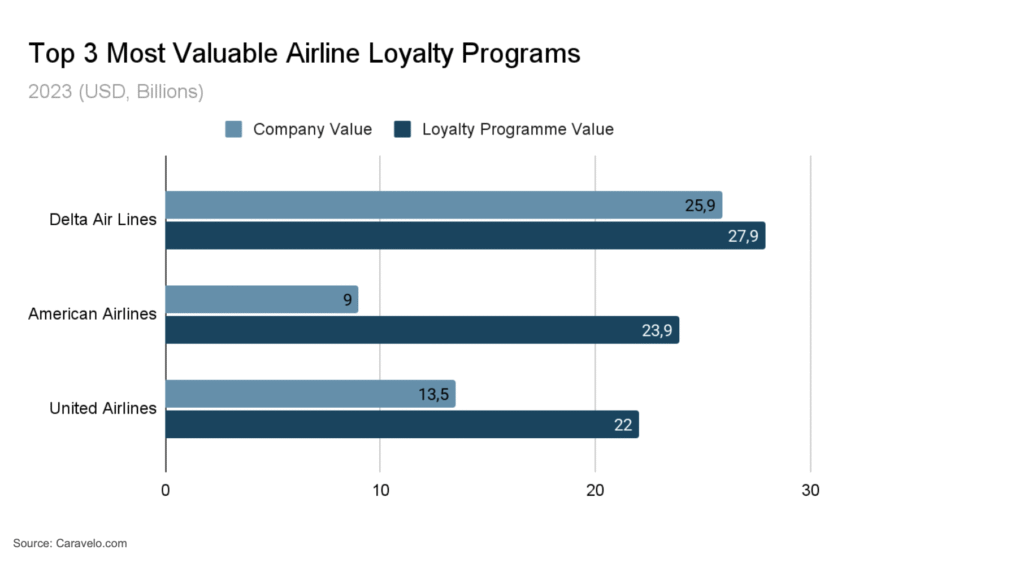
It may sound surprising, but analysts have repeatedly shown that many loyalty programmes are worth more than the airlines that run them. Studies in recent years valued Delta SkyMiles, American Airlines AAdvantage, and United Airlines MileagePlus in the tens of billions of dollars — exceeding the market value of the airlines themselves.
This says a lot about where the real money is in aviation today.
Conclusion and Key Takeaways
- Loyalty programmes have shifted from simple marketing tools to highly profitable, strategic businesses.
- Their value lies not in flying passengers, but in controlling pricing, demand, and customer behaviour within a tightly managed ecosystem.
- In some cases, the loyalty programme is more valuable than the airline itself.
- For travellers, the message is clear: miles hold real value. And once you understand the economics behind them, it becomes obvious why airlines often earn the most money from the “free” flights they give away.
For hotels, airline loyalty programmes offer an important lesson: the most valuable revenue streams are often the least visible.
Pricing, loyalty, payments and distribution decisions can quietly become high-margin financial products — or missed opportunities — depending on how they are designed.